


What is SDR (Software Defined Radio)? A Complete Guide for Beginners
SDR has become widely used in RF research, wireless communication development, spectrum monitoring, signal analysis, and education. With an SDR receiver, engineers and developers can explore a wide range of radio frequencies using a computer and specialized software.
What Does SDR Stand For?
SDR stands for Software Defined Radio.
In traditional radio systems, most functions such as filtering, modulation, and signal processing are performed by hardware components. This means each radio device is designed for a specific purpose and frequency range.
SDR changes this approach by moving many radio functions from hardware into software. The hardware mainly receives and converts RF signals, while software processes and analyzes the data.
This makes SDR devices more flexible and easier to upgrade compared with conventional radio systems.
How Does SDR Work?
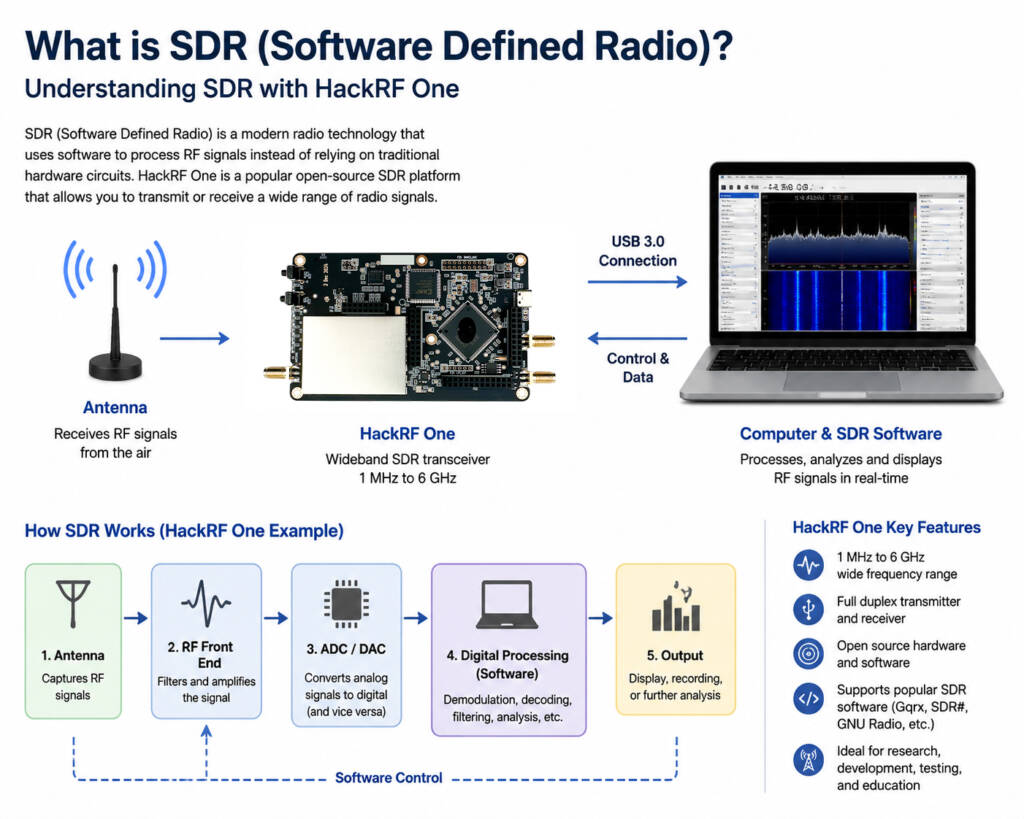
An SDR system usually contains several important parts:
1. Antenna
The antenna receives radio frequency (RF) signals from the environment.
2. RF Front End
The RF front end processes incoming signals by performing functions such as amplification, filtering, and frequency conversion.
3. Analog-to-Digital Converter (ADC)
The ADC converts analog RF signals into digital data that can be processed by software.
4. Software Processing
The computer or embedded processor analyzes the digital signals. Users can use different software applications to decode, visualize, or modify the signals.
The basic SDR signal flow is:
Antenna → RF Front End → ADC → Software Processing → Data Analysis
Because many functions are controlled by software, one SDR device can support multiple applications without changing the hardware.
SDR vs Traditional Radio
| Traditional Radio | SDR |
|---|---|
| Hardware-based design | Software-based design |
| Fixed function | Flexible configuration |
| Difficult to upgrade | Easy software updates |
| Limited applications | Supports many applications |
| Requires dedicated hardware | Uses programmable software |
The flexibility of SDR makes it an important tool for modern RF engineers and wireless communication developers.
Common Applications of SDR
RF Research and Development
SDR is widely used by engineers to test and analyze wireless communication systems, antennas, and RF circuits.
Spectrum Monitoring
SDR receivers can capture and analyze signals across different frequency ranges, making them useful for spectrum observation and signal measurement.
Wireless Communication Testing
Developers use SDR platforms to experiment with communication technologies such as:
- WiFi
- Bluetooth
- LoRa
- Cellular communication
- Digital radio systems
Signal Analysis and Education
SDR provides an affordable way for students, researchers, and engineers to learn about RF signals and wireless technologies.
Popular SDR Devices
There are many SDR platforms available for different applications.
HackRF One
HackRF One is a popular open-source SDR platform designed for RF experimentation, research, and education. It supports a wide frequency range and works with various SDR software tools.
LimeSDR
LimeSDR is a flexible SDR platform used for wireless communication development, prototyping, and RF research.
KrakenSDR
KrakenSDR is a multi-channel SDR system designed for applications such as direction finding and signal localization.
RTL-SDR
RTL-SDR is an affordable SDR receiver widely used for learning, spectrum monitoring, and basic RF exploration.
Explore more SDR devices and RF solutions
How to Choose an SDR Device?
When selecting an SDR device, several factors should be considered:
Frequency Range
Different SDR devices support different frequency ranges. Choose a device that covers the frequencies required for your application.
Bandwidth
Bandwidth determines how much spectrum the SDR can capture at one time.
Software Compatibility
A good SDR platform should support popular software tools and operating systems.
Application Requirements
Consider whether the SDR will be used for:
- RF testing
- Signal monitoring
- Wireless development
- Education
- Research projects
SDR and the Future of RF Technology
As wireless technologies continue to develop, SDR plays an increasingly important role in RF innovation.
From research laboratories to industrial applications, SDR provides engineers with a flexible way to explore, test, and develop wireless systems.
The combination of powerful hardware and software-based signal processing makes SDR an essential technology in modern radio communication.
Conclusion
SDR (Software Defined Radio) is a flexible radio technology that replaces many traditional hardware-based radio functions with software processing.
With advantages such as wide frequency coverage, programmability, and adaptability, SDR devices are widely used in RF research, communication testing, spectrum monitoring, and education.
For engineers and developers who want to explore wireless signals, SDR provides a powerful and practical solution.
Explore more for RF Hub
