


Introduction: What is RF?
RF stands for Radio Frequency, which refers to electromagnetic waves used for wireless communication and signal transmission.
The RF frequency range is commonly defined from 3 kHz to 300 GHz. RF technology enables devices to communicate without physical connections and is widely used in wireless communication, IoT, radar systems, satellite communication, and RF testing equipment.
Today, RF technology is an essential part of modern electronics, connecting billions of devices through wireless networks.
Explore more RF technologies, products, and applications in our RF Hub.
How Does RF Work?
RF communication works by transmitting information through electromagnetic waves.
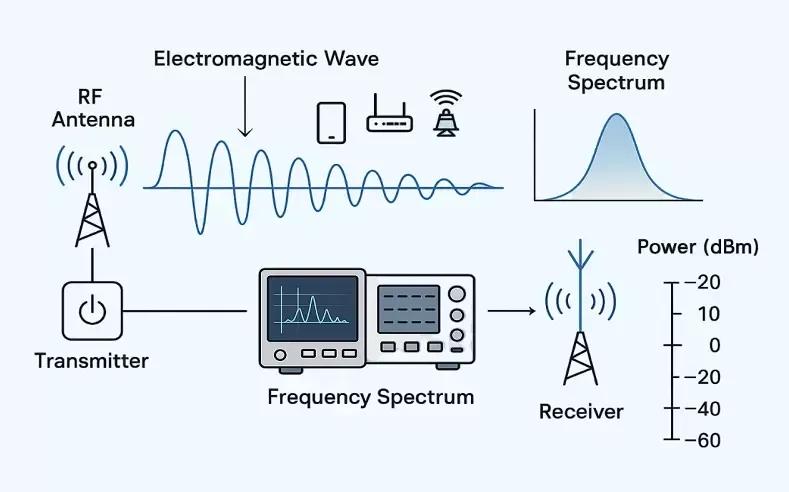
A basic RF communication system usually includes:
- RF transmitter
- RF receiver
- Antenna
- Signal processing unit
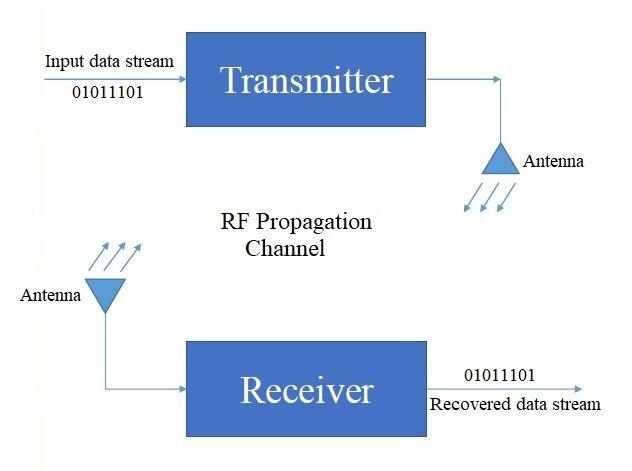
The transmitter converts electrical signals into RF signals and sends them through an antenna. The receiver captures the RF signal through an antenna and converts it back into usable information.
Basic RF communication process:
Data Signal
↓
RF Modulation
↓
RF Transmitter
↓
Antenna
↓
Wireless Channel
↓
Receiver
↓
Data Processing
RF Frequency Bands
Different applications use different RF frequency ranges.
Common RF frequency bands include:
| Frequency Range | Application |
|---|---|
| LF (30-300 kHz) | RFID, navigation |
| HF (3-30 MHz) | NFC, short-range communication |
| VHF (30-300 MHz) | Radio communication |
| UHF (300 MHz-3 GHz) | WiFi, Bluetooth, IoT |
| Microwave (3 GHz-300 GHz) | Radar, satellite, 5G |
Choosing the correct frequency band is important for RF system performance, antenna design, and communication distance.
Main Components of an RF System
A complete RF system usually contains several key components.
RF Module
An RF module is a compact electronic device that integrates RF circuits for wireless communication.
RF modules are commonly used in:
- IoT devices
- Wireless sensors
- Remote controls
- Industrial communication systems
Examples include:
- LoRa modules
- WiFi modules
- Bluetooth modules
- Sub-GHz RF modules
Antenna
An antenna converts electrical signals into electromagnetic waves and receives RF signals from the environment.
A proper antenna design affects:
- Transmission distance
- Signal quality
- RF efficiency
Common antenna types include:
- PCB antenna
- Dipole antenna
- SMA antenna
- External RF antenna
LNA (Low Noise Amplifier)
An LNA is an RF component designed to amplify weak received signals while adding minimal noise.
It is commonly used in:
- SDR receivers
- Satellite communication
- RF measurement systems
PA (Power Amplifier)
A Power Amplifier increases RF transmission power.
PA modules are used when a system requires:
- Longer communication distance
- Higher output power
- Better signal coverage
RF Applications
RF technology is widely used in many industries.
Wireless Communication
Examples:
- Mobile networks
- WiFi
- Bluetooth
- Satellite communication
Internet of Things (IoT)
RF technology allows smart devices to communicate wirelessly.
Applications include:
- Smart sensors
- Industrial monitoring
- Smart homes
Software Defined Radio (SDR)
SDR technology uses software to process RF signals instead of relying only on traditional hardware circuits.
Popular SDR devices include:
- HackRF
- LimeSDR
- RTL-SDR
SDR is widely used for:
- RF learning
- Signal analysis
- Wireless research
RF Testing and Measurement
Engineers use RF testing equipment to analyze and optimize wireless systems.
Common RF test equipment includes:
- Spectrum analyzer
- Vector network analyzer
- RF signal generator
- RF shield box
How to Choose RF Components?
When selecting RF components, engineers usually consider:
Frequency Range
The component must support the required operating frequency.
Example:
433MHz, 868MHz, 915MHz, 2.4GHz
Transmission Distance
Longer distance applications may require:
- Higher antenna gain
- RF amplifier
- Better receiver sensitivity
Signal Quality
Important parameters include:
- Gain
- Noise Figure
- Bandwidth
- VSWR
- Return Loss
Application Requirements
Different applications require different RF solutions.
For example:
- IoT devices → RF modules
- RF research → SDR devices
- Testing → RF measurement equipment
Conclusion
RF technology is the foundation of modern wireless communication.
From IoT devices and SDR platforms to RF testing systems, RF components play an important role in connecting electronic devices.
Understanding RF fundamentals, frequency bands, antennas, RF modules, LNA, and PA helps engineers design better wireless systems.
At DZ-RF, we provide RF-related solutions including RF modules, SDR devices, antennas, RF components, and testing equipment for engineers and developers worldwide.
FAQ: Frequently Asked Questions About RF
What does RF stand for?
RF stands for Radio Frequency, which refers to electromagnetic waves used for wireless communication.
What frequency range is RF?
RF generally covers frequencies from 3 kHz to 300 GHz.
What are RF components?
RF components include antennas, RF modules, LNA, PA, filters, connectors, and RF testing devices.
What is the difference between RF and wireless communication?
RF is the technology that enables wireless communication by transmitting electromagnetic signals.
